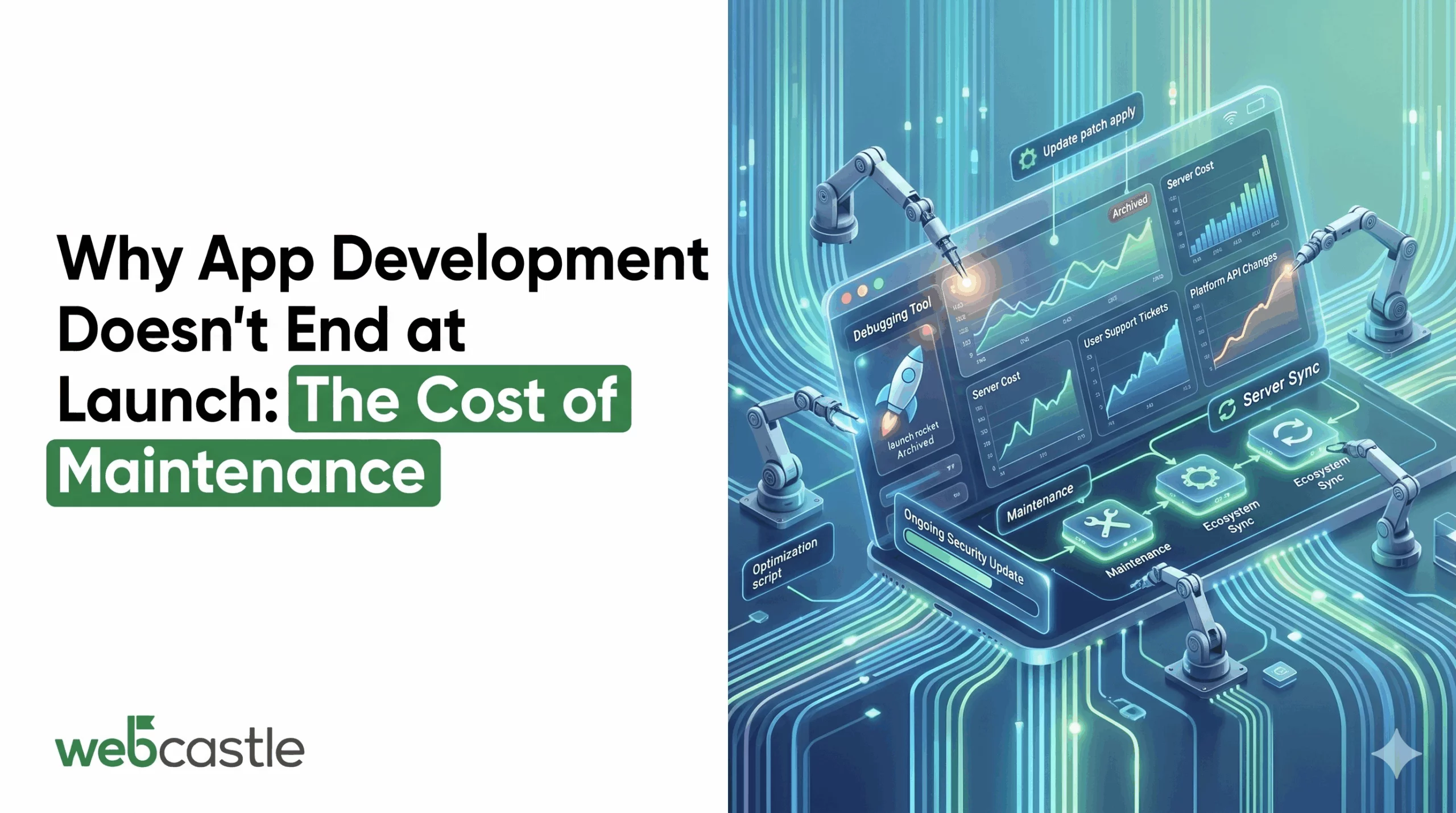
Launching an app is worth celebrating. It takes months of planning, building, testing, and refining to go from idea to a real product in users’ hands—and that’s not easy. But here’s the thing nobody emphasizes enough at that moment: launch day is not the end of anything. It’s closer to the end of the beginning.
A few months later, attention shifts. The app runs in the background. Small issues get ignored—until something breaks. An update fails, a payment stops working due to third-party API deprecation, or ignored bugs can impact ratings and downloads. Server hosting fees continue—even when the app isn’t actively maintained. Small problems can turn into costly ones.
This guide explains mobile app maintenance costs—what they are, why they matter, and how to manage them so you can make better decisions.
What Mobile App Maintenance Costs — and What It Covers
A figure that comes up consistently across the development industry: annual maintenance tends to run between 15% and 20% of what the original build cost. Build an app for $80,000 and you’re looking at somewhere between $12,000 and $16,000 per year to keep it in good health. That’s not a made-up vendor statistic; it’s what teams who do this for a living consistently report spending.
What does that money actually buy?
- Bug resolution: Every app ships with problems that testing didn’t catch. Real users on real devices in real network conditions expose things lab environments never do. Catching these early and fixing them is much cheaper than waiting for a one-star review campaign to force your hand.
- OS updates compatibility: Apple and Google typically release major platform updates each year. Updates can break things—layouts, permissions, or old functions. Staying up to date takes active work.
- Performance monitoring: Apps often slow down over time as data grows and systems change. Regular monitoring keeps performance stable.
- Security patching: Security issues are found often in libraries and systems. If your app handles payments or user data, quick updates are essential to avoid technical and legal risks.
- Incremental feature development: User needs shift. Competitor apps add functionality. An app that looked complete at launch can start to feel dated within eighteen months if nothing is being added. Small, regular improvements matter for retention.
The Costs That Catch People Off Guard
Predictable maintenance is manageable when it’s budgeted for. What does real damage is the category of costs that appear without much warning. These are important to understand before they happen:
- Modern apps rely on services like maps and payments. These change often, so regular updates are needed. Sometimes with adequate notice, sometimes not. When a payment gateway retires an older API version or a mapping provider restructures its pricing and access model, your app needs to be updated to match — or features stop working. This isn’t theoretical. Services like Google Maps, Stripe, and Twilio change often, so apps need regular updates.
- The Apple App Store and Google Play Store also update rules, so apps must adapt to stay compliant. New privacy disclosure formats, updated minimum SDK requirements, changes to in-app purchase rules. Apps that don’t meet current standards can be removed from the store—even without bugs.
- Rules also keep changing. Laws like GDPR, HIPAA, and CCPA evolve, so apps need updates to stay compliant.
The Costs That Catch People Off Guard
Common issues apps face over time:
- API changes
Services like Google Maps, Stripe, and Twilio update often. If your app isn’t updated, features can stop working. - App store rules
The Apple App Store and Google Play Store change policies regularly. Apps that don’t comply can be removed. - Changing regulations
Laws like GDPR, HIPAA, and CCPA evolve. Apps need updates to stay compliant. - Traffic spikes
Sudden growth can overload your system. If the app slows or crashes, users have a poor experience. - Code complexity (technical debt)
Quick fixes and shortcuts make code harder to manage over time. Updates take longer, and small changes can break other parts.
Technical Debt: The Bill That Arrives Late
Technical debt isn’t just a tech issue—it’s a business one. It comes from quick decisions made under pressure that solve problems now but create issues later. The shortcut worked. The feature shipped. The code becomes messy, so every future change gets harder and slower.
What makes it risky is that it keeps getting worse over time. A codebase with moderate technical debt in year one often has severe technical debt by year three if nothing is done about it. New features get layered on top of old shortcuts. Workarounds build on workarounds. Over time, teams spend more time dealing with complexity than building new features. At that point, fixing the code becomes urgent.
The solution is regular code refactoring. This means cleaning up the code over time to keep it easy to manage, without changing how the app works for users. It’s not visible work. It doesn’t produce new features. But it’s what keeps an app actually buildable over a multi-year horizon without costs spiraling.
Businesses working with a serious best mobile app development company in Boston should expect technical debt reduction to be part of ongoing maintenance conversations — not something that only comes up once the damage is already done.
Cloud Infrastructure: Scaling With Demand, Not After It
At launch, a new app usually runs on infrastructure sized for a small user base. That’s cost-efficient—but growth can outpace it. Platforms like Amazon Web Services, Google Cloud, and Microsoft Azure support scaling cloud infrastructure to handle spikes—but only if configured properly.
Poor auto-scaling can be too slow or too costly. Both outcomes have real consequences. Managing cloud infrastructure properly is an ongoing activity involving monitoring, right-sizing, caching strategy, and load-balancing — not a configuration that gets set once at launch.
There is also a coordination issue that comes up repeatedly in practice. A marketing campaign drives a surge in traffic. The app cannot handle it and degrades or crashes. The marketing team is surprised. The technical team is surprised. The users are frustrated. That sequence is preventable — but only when marketing and development are actually talking to each other ahead of time rather than operating as separate departments.
This is where having a digital marketing company in Boston that coordinates with your technical team pays off in concrete terms. When your infrastructure is ready for the demand your campaigns are about to generate, campaigns perform better. When it isn’t, they underperform regardless of how good the creative is.
A Practical Way to Think About This
If you already have an app live in the market, the most useful question to ask yourself right now is honest: when did someone last look at it properly? Not just check that it was running, but actually review OS compatibility, security status, open bug reports, performance baselines, and the state of the codebase? If the answer is uncertain, or if the answer is ‘a while ago,’ that is worth acting on before something external forces the issue.
If you are planning a new build, the smartest thing you can do is budget for maintenance before you start rather than treating it as a future problem. An app that costs $90,000 to build and $15,000 per year to maintain properly will significantly outperform one built for the same price and then left to run unattended. The difference shows up in stability, in ratings, in user retention, and ultimately in the return on the original investment.
Mobile app maintenance is not overhead. It is what functioning software in a changing environment actually requires. The businesses that understand this tend to get sustained value from their technology. The ones that treat launch as the end of the work tend to find themselves rebuilding from scratch far sooner than they expected.
Want a straight conversation about what your app actually needs?
WebCastle is a trusted app development company in Boston that works with businesses from initial build through long-term product maintenance. If you’d like a direct, jargon-free assessment of where your app stands and what keeping it healthy will realistically cost, get in touch here. We’ll give you a clear picture — no pressure, no obligation.
Get in touch with WebCastle for a quick, no-obligation assessment.
