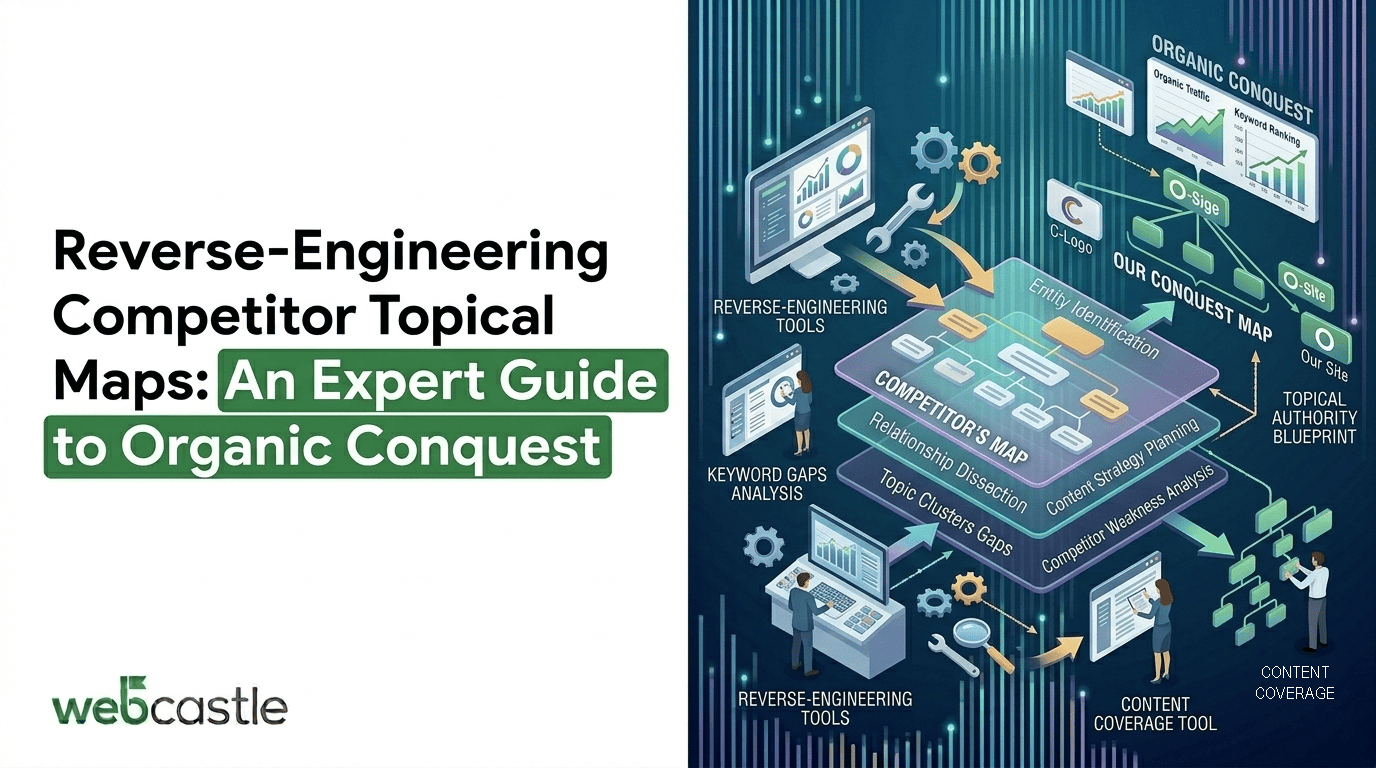
Why Competitor Content Maps Are Worth Your Attention
Many SEO teams focus on keywords but overlook the content structures driving competitor rankings. These gaps can become valuable opportunities to improve your own SEO performance. At Castle, competitor topical mapping and topical mapping strategy are often among the first steps used to uncover those opportunities.
This guide explains how to analyze competitor topical maps and turn the insights into an SEO growth plan.
What a Topical Mapping Strategy Actually Is
A topical map is a structured plan for covering a subject comprehensively enough that search engines can recognize your site as an authoritative source on it. It is not a keyword list. A keyword list shows what to target, while a topical map reveals content gaps and SEO opportunities.
Building a Content Cluster
Content clustering architecture organises related content around a core topic. When analyzing competitors, focus on structure over content volume:
- Which pages serve as the main topic hubs and link to related content?
- Which supporting pages are clearly designed to feed authority back toward that hub?
- Which content clusters are developed, and which seem incomplete?
- What internal linking patterns suggest which clusters they have prioritized?
A competitor’s cluster structure reveals how successful content ecosystems are built. You can learn the shape of a winning structure from them and then figure out where your version of it needs to go further or in a different direction.
Semantic Node Depth: How Far Down the Rabbit Hole Have They Gone?
Within any cluster, there are layers. A competitor might have a solid pillar page on a broad topic and a handful of supporting articles on the obvious sub-topics. That is common. What separates the sites dominating competitive niches is that they have gone several layers deeper into the semantic structure of the subject.
Semantic node depth refers to how many levels of specificity a competitor has covered within a topic cluster. Shallow coverage focuses on the topic while deep coverage addresses questions, comparisons, use cases, and objections.
When checking a competitor’s content, the difference in depth often becomes clear:
- They have covered the broad category term and the obvious question-based variations
- They cover the most common supporting sub-topics
- They often overlook lower-volume keywords with strong commercial intent
Low-volume keywords may attract less traffic individually, but together they can strengthen topical coverage and drive valuable, lower-competition traffic.
Keyword Gap Analysis
Keyword gap analysis helps uncover missed opportunities by identifying gaps within content clusters. Focus on keyword gaps within relevant content clusters:
- Which of their clusters do you have no coverage in at all?
- Which clusters do you have some coverage in but are missing the hub page that would organize it?
- Which gaps exist in deeper content layers that competitors often overlook?
This approach turns keyword gaps into a clear, prioritized content plan.
Competitor Content Footprints: Reading the Strategy Behind the Output
A content footprint reveals a competitor’s content strategy.
Some things worth noticing when you map out a competitor’s footprint:
- Topics they covered heavily in the past but have not updated recently.
- Clusters they are actively expanding, often signaling growing demand.
- Content formats they consistently use in successful clusters, such as guides, comparisons, or FAQs.
- Areas where their content is thin or clearly produced quickly, which often corresponds to topics they entered opportunistically without a real coverage plan
The last point is particularly useful. A competitor’s weak spots are not always where they have no content. Sometimes they are where the content exists but is shallow, poorly structured, or outdated. Those areas can be taken with a well-planned cluster even when you are starting from behind on domain authority.
Search Volume Distribution: Not All Traffic Is Worth Chasing Equally
One of the more common mistakes in SEO planning is allocating effort proportionally to search volume. The logic seems sound: go after the terms people are actually searching. In practice it leads teams toward the most competitive terms in a space, which are also the ones that take longest to rank for and produce the least differentiated traffic. Search volume distribution shows how traffic is spread across a topic cluster. The deeper terms often offer the best balance of opportunity and competition.
High-volume keywords are highly competitive, while deeper semantic terms often offer easier ranking opportunities.
Putting the Analysis into Action
The practical process for reverse-engineering a competitor topical map involves several steps, and the sequence matters. Starting with the keyword gap before you understand the cluster structure produces a list. Starting with the cluster structure first produces a strategy.
A workable approach looks roughly like this:
- Identify three to five competitors that consistently outrank you across key topic areas.
- Audit their full content inventory, organized by topic cluster rather than by date or volume
- Map the semantic node depth for each cluster, noting which layers they have covered and which they have not
- Run the keyword gap analysis and sort the results by cluster rather than by raw volume
- Analyse their search volume distribution across each cluster to identify where effort is underrepresented relative to the opportunity
- Build your own content plan around the gaps and the depth layers they have left open, starting with the clusters where you already have some presence
This kind of structured competitor analysis takes more time upfront than a standard keyword research pass. The payoff is a content roadmap that builds toward topical authority rather than one that produces individual pages with no organizing logic behind them.
Webcastle, one of the top SEO agency in Boston has worked through this process with clients across a range of competitive verticals. Strong SEO results come from a solid content structure. If your content is not gaining momentum, the issue is often organization and strategy rather than writing quality.
The Case for Doing This Now Rather Than Later
Topical authority compounds. A competitor who has been building structured content clusters for two years is not just two years ahead of you, they are much further ahead than that, because the authority they have built in those clusters makes every new piece of content they publish more effective than yours at equivalent quality.
Finding those openings requires doing the mapping work thoroughly. A quick keyword gap report is not enough, Understanding your competitive landscape helps you build content that delivers lasting value.
The goal is not to publish more content, but to build a stronger content ecosystem than your competitors.
That is the shift worth making.
If you’d like to learn more about Castle’s approach to topical mapping and competitor content analysis, get in touch with our team.
