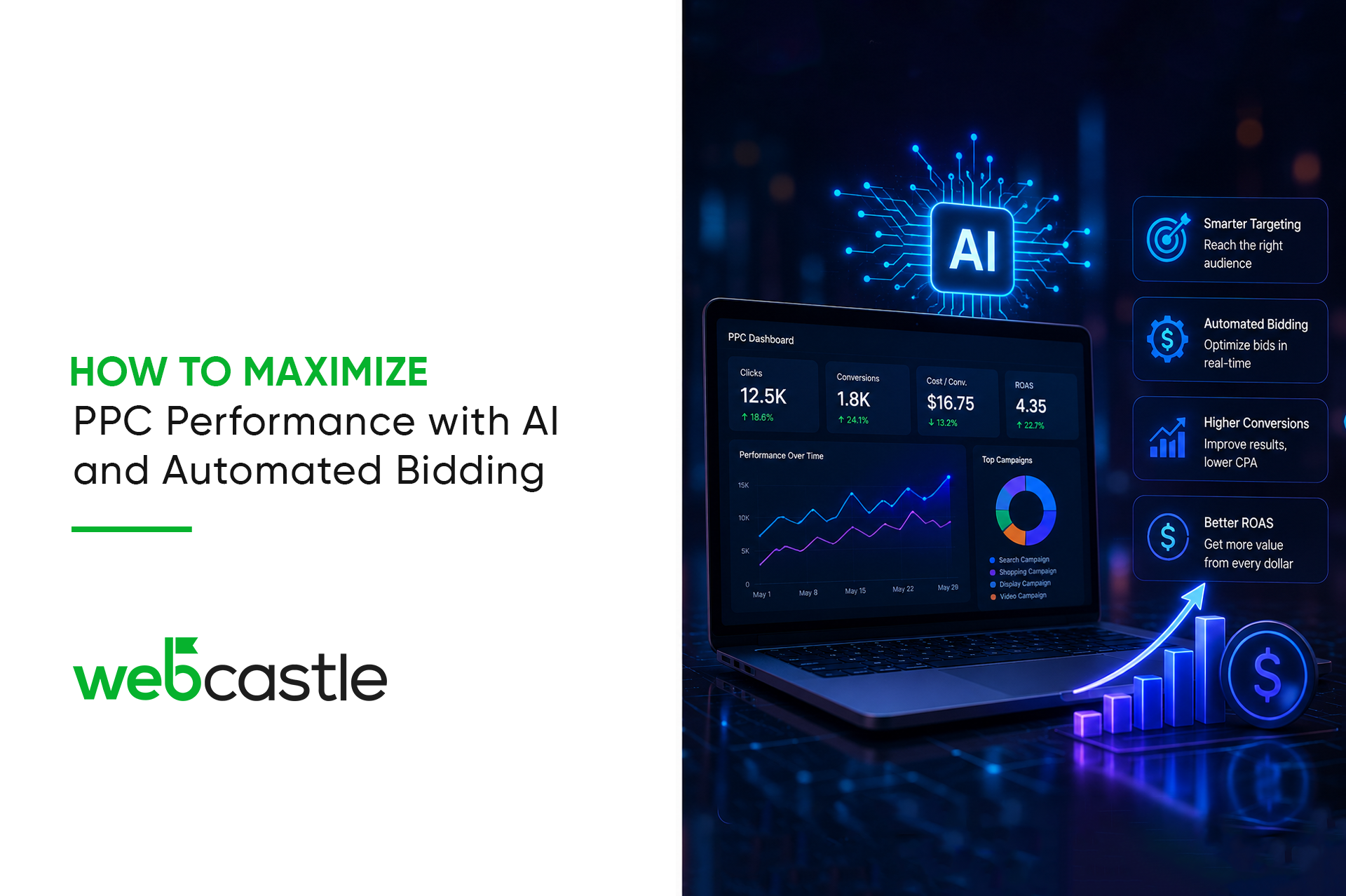
Running PPC manually is like trying to drive by only looking in the rearview mirror. You adjust bids based on what happened yesterday, but every auction is happening right now, with signals you never even see. That lag costs money, quietly, every single day.
AI automated bidding closes that gap. Businesses looking to maximize PPC performance increasingly rely on AI in Google Ads to improve campaign efficiency and results. This post breaks down how it works, which strategies to use, and what to watch out for when setting it up.
What Is AI Automated Bidding in PPC?
Each Google search kicks off an auction. Whether your ad appears, and what you pay for that click, depends partly on your bid. Manual bidding means you pick that number. Automated bidding means an algorithm picks it, using live signals from the person searching.
We’re talking about signals like the device they’re on, their location, the exact words they typed, time of day, and patterns from their past browsing. The system reads all of it in milliseconds and decides what that particular click is worth, not what clicks were worth last week on average.
Google’s Smart Bidding runs on this model, using machine learning to adjust bids based on real-time auction signals. It is widely used and has a proven track record across a range of campaign types.
Manual Bidding vs. AI Bidding — Key Differences
- Speed: Manual bids get updated when someone logs in. AI bids update for every single auction, in real time.
- Scale: You can manually manage a few hundred keywords before things slip. AI handles thousands without losing focus.
- Signal depth: Manual strategies might factor in device and time of day. AI is reading behavioral signals that no human segmentation would ever isolate.
Top Automated Bidding Strategies to Use
Target CPA — Best for Lead Generation
You tell Google the maximum you want to pay per conversion, and the algorithm tries to hit it. Simple in theory, but the target you set matters enormously.
If your real CPA over the last three months is $75, setting a target of $25 won’t push performance, it’ll strangle it. The algorithm either restricts impressions heavily or stops spending. Set your target close to your actual historical number and reduce it gradually once things are stable.
Target ROAS — Best for E-commerce
Instead of optimizing for conversion count, Target ROAS optimizes for revenue. You set a return ratio, say $5 for every $1 spent, and bids are built around that goal across your entire product catalog.
This matters especially when your products span a wide price range. A $350 item and a $20 item shouldn’t carry the same bid. Target ROAS accounts for that value difference automatically, pushing harder for the purchases that actually move revenue.
Good revenue tracking is essential here. If your purchase values aren’t coming through to Google Ads correctly, the algorithm is learning from bad data.
Maximize Conversions — Best for Budget Flexibility
No target, no ratio. This strategy just takes your daily budget and chases as many conversions as it can find.
It’s the right call for new campaigns where there’s no historical data to base a target on. Let it run, collect conversion data, then layer in a CPA or ROAS target once you have something real to work from. Keep an eye on actual costs during this phase since CPAs can wander without a ceiling.
Benefits of AI in PPC Campaigns
- Lower CPA and stronger ROAS: AI focuses budget on clicks most likely to convert.
- 24/7 optimization: Bids adjust continuously, even outside business hours.
- Better audience insights: AI identifies valuable customer patterns that may be missed in standard reports.
- More time for strategy: Teams can focus on creative, landing pages, and campaign growth instead of manual bid management.
How to Set It Up — 3 Simple Steps
Step 1 — Fix Your Conversion Tracking First
Skip this and everything else falls apart. AI bidding learns from your conversion data, so if that data has gaps, duplicates, or misconfigured values, the algorithm is being trained on false information from the start.
Go through each conversion action before you touch your bidding setup. Confirm they’re firing on the right events, check for duplicates, and if you’re using Target ROAS, make sure transaction values are passing through accurately.
Step 2 — Pick the Right Bidding Strategy
Match the strategy to what your campaign is actually for. Lead gen with a cost target goes to Target CPA. Revenue-focused e-commerce goes to Target ROAS. A new campaign with no real data goes to Maximize Conversions.
Don’t pick based on what sounds most advanced. Choose the strategy that best matches your goals.
Step 3 — Let It Learn, Then Scale
Smart Bidding strategies typically require one to three weeks of learning, depending on campaign activity and available conversion data. Performance during that window will be uneven. That’s normal during the learning phase.
The mistake is treating the learning phase like a crisis and making changes. Adjusting targets, pausing campaigns, or switching strategies mid-learning resets the clock entirely. Wait it out. When performance evens out and targets are consistently being met, then push the budget or expand your targeting.
Mistakes to Avoid
- Changing strategies too soon. Give the strategy time to learn and optimize. Early numbers aren’t reliable.
- Targets that don’t reflect your data. An aggressive target without the historical performance to back it is just a restriction in disguise.
- Not enough conversions before automating. Smart Bidding performs best when campaigns generate consistent conversion data. Higher conversion volume generally leads to better optimization.
- Overreacting to the first two weeks. Instability during learning is normal. Pull the plug too early and you’ll never know what the strategy could have done.
Conclusion
Getting AI automated bidding right isn’t complicated, but it does require accurate tracking and realistic goals. When implemented correctly, automated bidding strategies can help businesses improve efficiency and maximize PPC ROI.
Looking for a trusted Digital Marketing Agency in Boston? The team at WebCastle helps businesses build PPC campaigns that actually work, from fixing tracking to scaling what performs. If your current setup isn’t delivering, that’s where the conversation starts.
