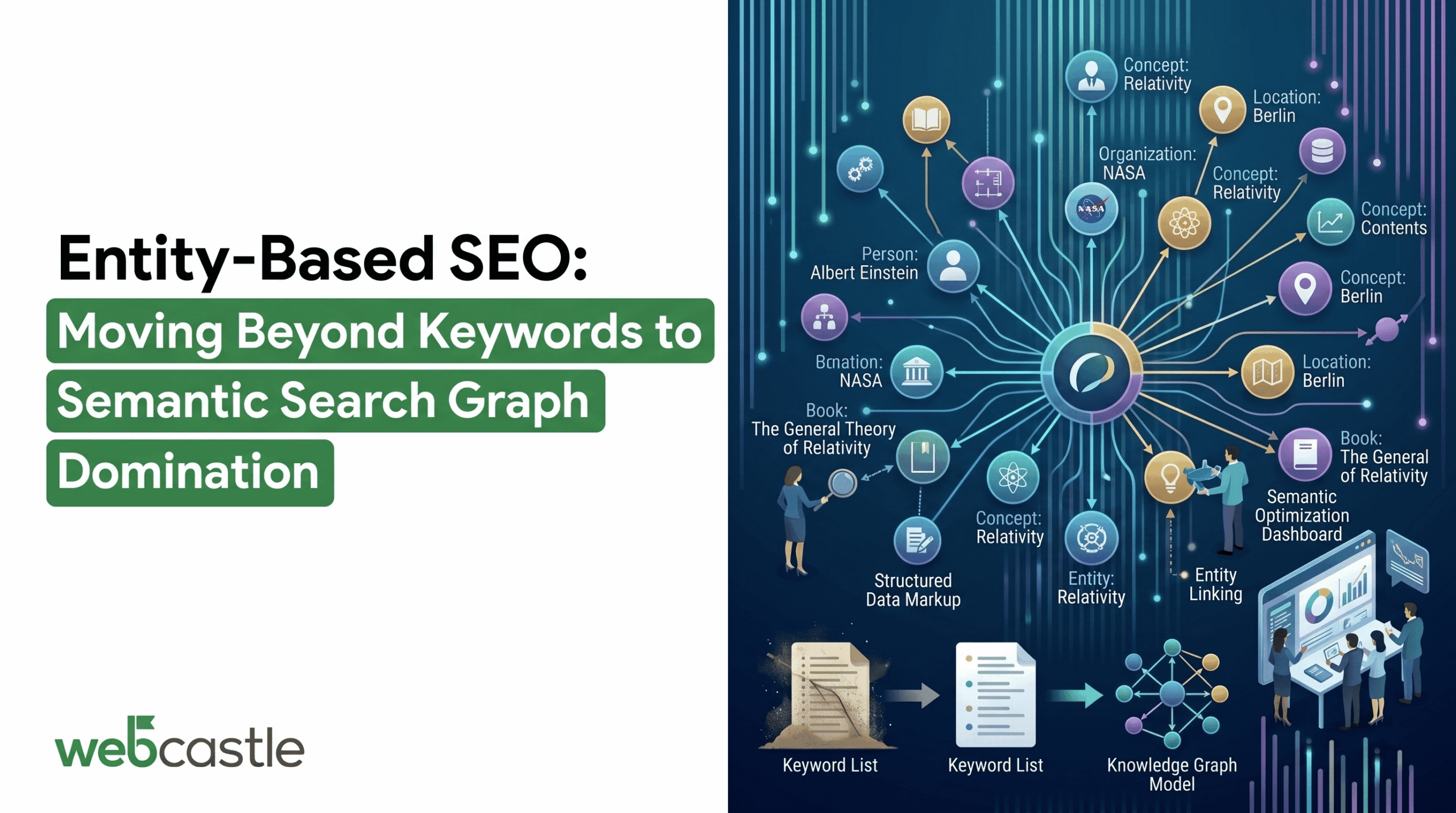
For years, SEO meant one thing: find the right keywords and rank for them. That still matters. But Google has shifted the roles. As of May 2024, Google’s Knowledge Graph holds over 1.6 trillion facts about 54 billion entities, powering everything from Knowledge Panels to AI Overviews. Google increasingly evaluates the credibility and relevance of brands before displaying them prominently in search results. That’s a different problem. And it needs a different solution.
This blog breaks down what an entity-based SEO strategy actually looks like, why schema markup object architecture matters more than keyword density, and how WebCastle helps businesses become trusted entities, not just ranked pages.
Your Keywords Are Ranking. Your Brand Is Still Unknown.
Here’s a scenario that should bother you.
You’ve invested in SEO. Your pages rank. Traffic comes in. But when someone asks Google, “Who are the top web development agencies in Boston?” – your company doesn’t appear in the AI Overview. No Knowledge Panel. No rich snippets. Just another blue link buried in a list.
That’s the keyword trap. You optimized for strings. Google is now thinking in terms.
The Problem: Google Doesn’t Read Your Page the Way You Think
Traditional SEO taught us to feed search engines the right words. Repeat the keyword. Build links. Add it to the title tag.
That model is functionally outdated.
Google’s algorithm no longer matches queries to content; it also considers the context of the query. It maps queries to entities – people, places, organizations, concepts – and then evaluates relationships between those entities. It’s not reading your page like a user. It’s reading it like a fact-checker.
How Google Understands Entities
Google maintains a massive semantic database called the Google Knowledge Graph.
These aren’t just keywords. They’re connected data that helps Google understand context. Each node has attributes (name, location, category, founding date) and relationships (“Company X” → “operates in” → “Boston” → “serves” → “eCommerce brands”).
When someone searches “best Boston web agency,” Google isn’t just retrieving pages with that phrase. It’s querying its graph for entities that match the concept. If Google doesn’t clearly understand your business, you don’t appear as an answer. You appear as a guest.
Where Most SEO Strategies Break Down
- No clear business definition: Your site never explicitly tells Google what kind of entity it is. Are you a Person? Organization? LocalBusiness? Without schema markup, Google has to make assumptions about your business.
- Orphaned content: Pages exist without topical nodes connecting them. Your blog post on eCommerce SEO and your service page on web development are strangers to each other. Google sees fragmentation, not authority.
- Keyword repetition without context: Stuffing “web design Boston” into 14 places doesn’t teach Google what your organization does, who it serves, or how it relates to adjacent entities.
- No verification from trusted sources: The Knowledge Graph cross-references Wikidata, Wikipedia, LinkedIn, Crunchbase, and other authoritative sources to verify business information.
The Solution: Build Your Brand as an Entity, Not Just a Website
An entity-based SEO strategy treats your brand as a node in Google’s knowledge graph. The goal is not just to rank; it’s to help Google understand and trust your business. Here’s how that works in practice.
1. Define Your Entity with Schema Markup Object Architecture
Schema markup is the most direct signal you can send Google. It’s the difference between Google guessing what your brand is and Google knowing.
Start with JSON-LD on your homepage and key service pages. At minimum, declare:
- Organization (with name, URL, logo, foundingDate, address)
- LocalBusiness (if location-specific – critical for Boston-based services)
- Service (what you offer, who it’s for)
- sameAs properties linking to your LinkedIn, Crunchbase, Google Business Profile, and any Wikipedia/Wikidata entries
The “sameAs” property is often ignored. It’s one of the strongest trust signals in the Knowledge Graph. It tells Google: these external sources confirm this entity is real and consistent.
2. Build Topical Nodes and Connected Internal Links
Google’s semantic understanding isn’t just about what your homepage says. It’s about what your entire site says as a system.
Topic clusters build that system. The structure:
- One pillar page per core entity (e.g., “Web Development Boston” as the primary entity page)
- Supporting cluster pages around sub-entities (“eCommerce Development,” “Mobile App Development”, “SEO Services Boston”)
- Internal link clusters that connect these pages with descriptive internal links, not generic “click here” or “read more”.
Each internal link is a relationship signal. When your “Web Development” page links to your “SEO Services” page with anchor text like “search engine optimization for Boston businesses,” you’re reinforcing the relationship between two related topics in your site’s content graph.
3. Build Entity Confidence Through Semantic Search Optimization
Google doesn’t trust a new entity just because you declared it in schema. Trust grows when Google finds the same business details across multiple reliable sources.
Practical steps for semantic search optimization:
- Get listed on Crunchbase, LinkedIn, Apple Maps, and Google Business Profile with consistent NAP data (Name, Address, Phone)
- Earn mentions (not just links) from authoritative sites in your niche – a mention of “WebCastle USA” in a Boston tech publication teaches Google your brand name is associated with web development in Boston
- Publish content that explicitly references related entities – not just keywords. Mention partners, technologies, and industry organizations by name.
- Ensure your About page reads like an entity record: founding year, team, location, services, and specializations – all explicit
This is semantic search optimization at its core: giving Google enough consistent, structured, cross-referenced information so that your business becomes easier for Google to identify and trust.
4. The Google Knowledge Graph: Your Target Destination
The Knowledge Graph is not just an SEO tactic. It’s the database that feeds AI Overviews, Knowledge Panels, and voice search results. Brands that exist in it as well-defined entities get cited. Brands that don’t get bypassed entirely.
The path into the Knowledge Graph runs through:
- Clearly defining your business (schema markup)
- Third-party verification (Wikipedia, Wikidata, and authoritative mentions)
- Strong topic clusters that demonstrate expertise
- E-E-A-T signals, author credentials, company awards, client testimonials indexed at scale.
Stop Optimizing for Search Engines. Start Building Authority.
The era of keyword-only SEO is over.
The brands that will dominate search in 2026 and beyond won’t succeed simply because they publish good content. They’ll win because they’ve built a strong digital identity with semantic relevance, structured data, and deep topical authority that positions them as trusted entities in Google’s ecosystem.
Most businesses haven’t made this shift yet. That creates a unique opportunity to establish entity authority and gain a lasting competitive advantage.
The window is open today. It won’t stay open forever.
Ready to Become an Entity Google Trusts?
WebCastle USA, one of the best Digital Marketing agency in Boston, builds entity-first digital strategies – from schema markup implementation and topic cluster architecture to Knowledge Graph optimization and AI Overview positioning. We’ve worked with brands across Boston, Dubai, and beyond to turn their websites into recognized entities that search engines cite, not just crawl.
Still relying on keywords alone? It’s time to go beyond rankings and build real search authority. Discover how visible your brand is in Google’s Knowledge Graph and unlock new opportunities for long-term growth. Talk to the WebCastle team today.
