Let’s Be Honest About Where Most Teams Are
Here is a situation that probably sounds familiar. A customer you thought was happy suddenly cancels. You dig into the account history afterward and the warning signs were all there. Falling order frequency, fewer support interactions, and declining email engagement. But nobody caught it in time because nobody was looking in the right place.
That is not a people problem. It is a systems problem. And it is exactly the kind of problem predictive analytics in marketing was built to solve.
Now, before this starts sounding like a pitch for some expensive tech overhaul, it is worth saying that the barrier to doing this well has dropped dramatically. Teams that would have needed a dedicated data science department five years ago can now run meaningful churn models and demand forecasts with the right approach and reasonably clean data.
This post explains predictive analytics, how it works, and the challenges teams face.
What Predictive Analytics Does in Marketing
Predictive analytics uses past data to predict future outcomes. But the difference between doing this systematically versus relying on gut feel or manual reporting is enormous in practice.
In a marketing team, the kinds of questions this approach helps you answer include things like:
- Which customers are likely to leave before they actually do?
- Which customer groups may generate lower long term value than expected?
- When is demand likely to increase, and how early can you predict it?
- Which leads are most likely to convert right now?
These are not questions that get answered by pulling last quarter’s report. They require behavior tracking across multiple touchpoints, feeding that data into machine learning models, and setting up workflows that actually do something with the outputs.
Customer Churn: Why the Obvious Signals Are Usually Too Late
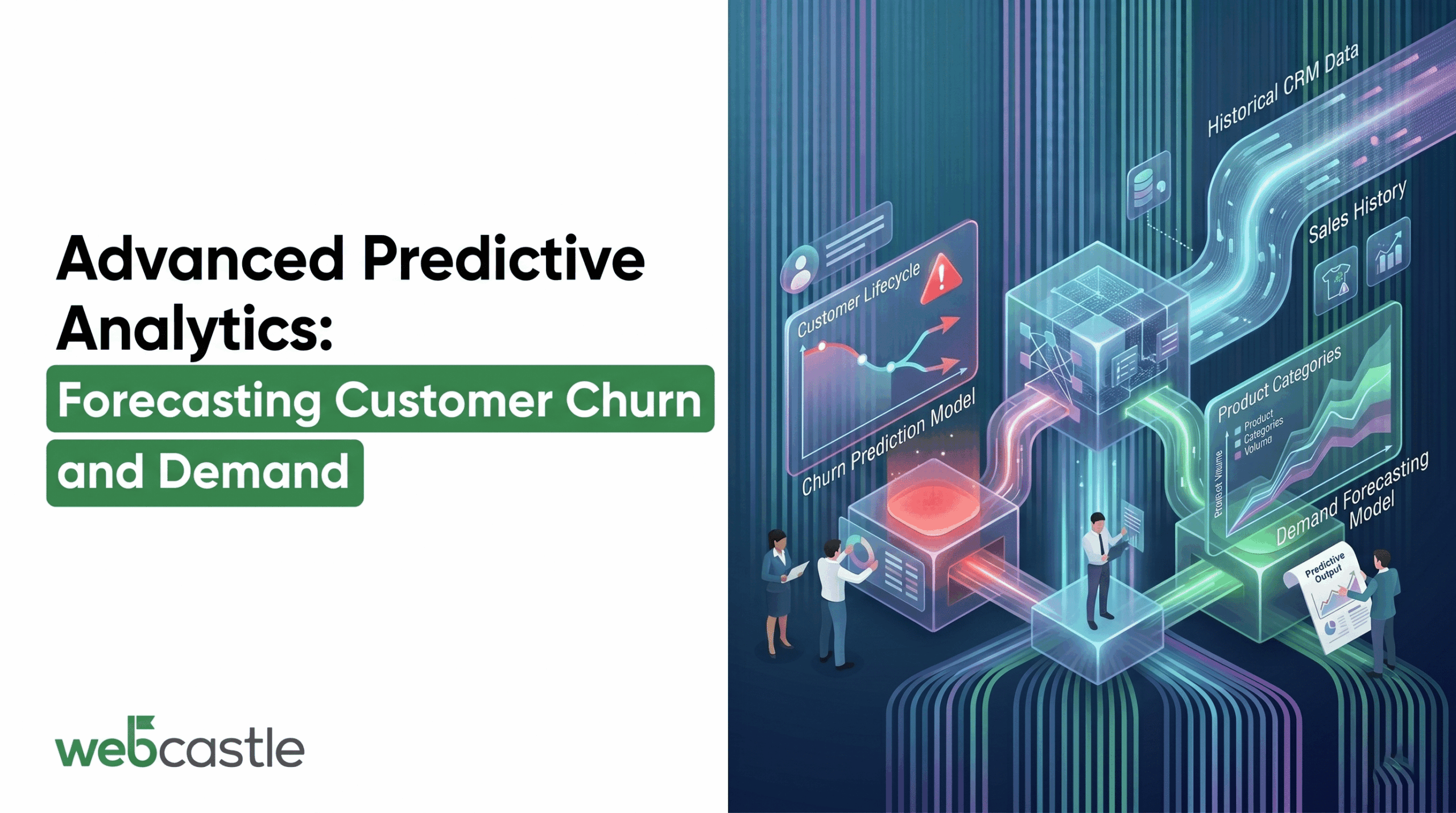
Most businesses track churn as a lagging metric. The customer leaves, then the number moves. Churn models look for early warning signs by analysing historical customer data. While the signals vary by industry, some patterns are common across many businesses
- Lower purchase frequency
- Declining email engagement
- More customer complaints
- Reduced platform activity
- Increased comparison shopping
When a model is trained on enough of this history, it can generate a churn probability score for every active customer on a rolling basis. High scores trigger interventions. These actions can be automated or reviewed manually. Often, a timely message or relevant recommendation is enough to keep customers engaged. The key is acting before they leave.
Where Customer Lifetime Value Fits Into This
Churn risk by itself is not enough to know how to respond. A customer with a 70% churn probability who has spent heavily for three years is a very different situation from a customer with a 70% churn probability who signed up eight weeks ago and has placed one order.
Customer lifetime value (LTV) is the bridge between churn risk and appropriate response. When LTV models are run alongside churn models, the prioritisation becomes much more defensible. You can make a clear business case for where retention spend goes and why, rather than applying the same treatment across all at-risk customers regardless of their actual value.
Demand Forecasting for Marketing Teams
Demand forecasting has traditionally been handled by finance teams. Marketing teams often build their plans around those forecasts. The problem is that those forecasts are often built without the behavioral and campaign data that marketing actually holds.
When marketing teams use data-driven forecasting, predictions can become more accurate by incorporating a wider range of customer and campaign data.
Effective data-driven forecasting relies on insights that marketing teams understand well:
- Historical sales data
- Seasonal trends
- Campaign performance
- Customer behavior signals
- Market and economic trends
The practical upshot is that marketing can stop guessing at budget timing and start planning it around real projections. That alone tends to improve campaign efficiency quite a bit.
A Plain-English Look at the Models Involved
You do not need to understand the maths behind predictive models. Several proven models are used for churn prediction.
- Logistic Regression: Simple and easy to understand.
- XGBoost and LightGBM: Highly accurate and effective with complex data.
- Random Forests: A balanced option that offers good accuracy and reliability.
For demand forecasting:
- ARIMA and similar time series models are the traditional choice when your data is clean and the patterns are relatively stable
- Prophet, developed by Meta, handles seasonality and irregular patterns well and has become a practical go-to for marketing-adjacent forecasting
One thing worth saying clearly: the quality of the data fed into these models matters far more than which model you pick. A logistic regression trained on two years of reliable behavioral data will consistently outperform a sophisticated gradient boosting model trained on patchy, inconsistently tracked inputs.
The Integration Problem Nobody Talks About Enough
There is a failure mode that comes up repeatedly in predictive analytics projects. The model gets built, validated, and signed off. Everyone is pleased with the accuracy metrics. And then six months later nothing has actually changed in how the business operates.
The reason is almost always the same. The predictions were never connected to anything actionable. They stayed in dashboards that few people had time to check regularly.
To create real value, forecasts must be integrated into everyday workflows:
- Automated retention campaigns through marketing automation platforms
- Forecast driven budget planning
- LTV based customer prioritisation
- Continuous model updates
When integrated properly, the system improves over time, making predictions more accurate and effective. It is a slow compound effect but it adds up.
Where Most Teams Need to Start
If you are reading this and thinking the gap between where you are now and where this describes sounds wide, that is a normal reaction. The businesses that succeed with predictive analytics do not build everything at once. They start with a clear goal, use reliable data, and focus on turning insights into better business decisions.
This is an area where Castle has done quite a bit of hands-on work. The goal is to identify where better predictions can improve decisions. If you are facing customer churn, uncertain demand, or underused data, predictive analytics may help.
To Wrap Up
Predictive analytics helps businesses make smarter decisions. Success comes from setting clear goals, using reliable data, and focusing on practical outcomes. The most successful businesses simply start early, stay focused, and improve over time. That is a playbook any team can follow.
If customer churn, demand forecasting, or underused data are limiting growth, predictive analytics can help turn insights into action.
WebCastle helps marketing teams turn predictive insights into better business decisions.
