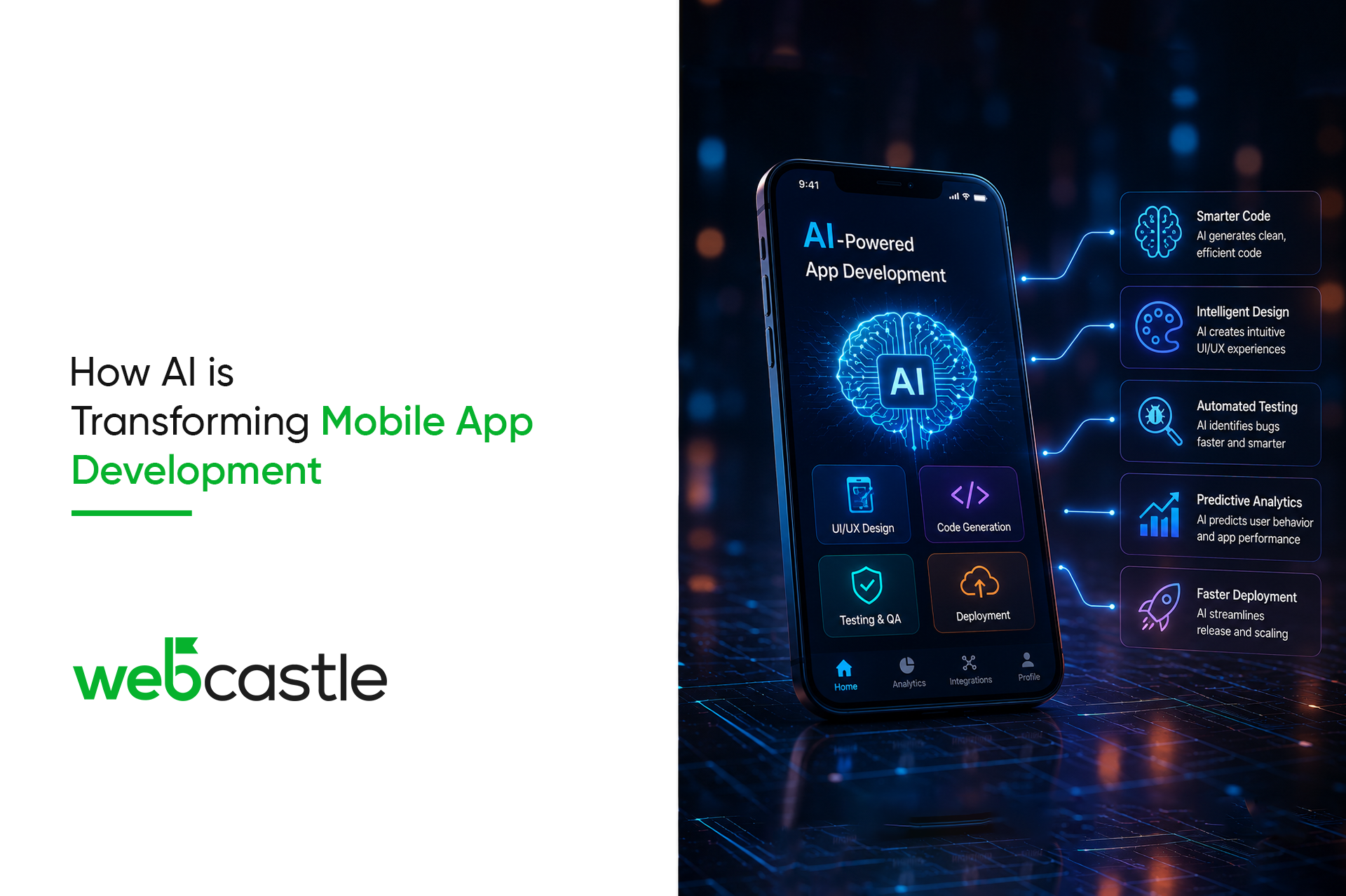
What developers gain is relief from the parts of their job that eat time without requiring much thought. Repetitive code structures, routine checks, predictable error patterns. Skilled engineers should not be spending their afternoons on that work, and increasingly they do not have to.
Three things shift when a team starts using these tools properly:
- Speed: AI accelerates coding, testing, and setup tasks.
- Smarter products: Machine learning mobile app development enables personalized user experiences.
- Cost control: Early bug detection reduces development and maintenance costs.
Key Ways AI Is Transforming Mobile App Development
AI-Powered Code Generation and Assistance
GitHub Copilot normalized something that felt experimental just a few years ago. Developers who use AI-powered mobile app development tools regularly have mostly stopped thinking of them as anything special. They are just part of the workflow now, the same way version control is.
On a working team, the differences are practical:
- Fewer errors make it to code review, so review time focuses on what matters.
- Senior developers stay on the complex work instead of getting pulled into fixing basic mistakes.
- Features get shipped on time more often because the small friction points that cause delays have been removed.
Smarter UX Through Personalization
Artificial intelligence in mobile apps has quietly raised the floor on what users expect. An app that serves the same content to a new user and a loyal one with years of history is leaving engagement on the table, and users notice even if they cannot articulate why.
Spotify and Netflix built retention around this principle early. What each person sees when they open those apps is shaped by real behavioral data, not editorial guesswork. Any business building a mobile product today can work toward the same outcome:
- Users stay in the app longer when what they see reflects how they actually use it.
- They come back more often when the experience does not feel generic.
- Revenue from in-app actions improves when the path to them feels natural.
AI-Driven Testing and Quality Assurance
Manual QA has real limits, and most teams bump into them regularly. Coverage shrinks under deadline pressure, testers miss things, and bugs that should have been caught in development end up in production instead.
AI app development tools do not work in scheduled blocks. They run continuously, catch regressions the moment they appear, and handle a volume of test cases that no human team could keep pace with during a normal sprint.
What teams tend to notice:
- Problems get fixed while the developer still has full context on the relevant code.
- Coverage holds steady even when the team is stretched thin.
- Releases do not pile up behind a QA backlog that ran out of time.
Intelligent Chatbots and Voice Assistants
Early in-app chatbots were genuinely bad. They worked within a rigid set of scripted replies, broke down on anything unexpected, and left users more frustrated than when they started. Many people still carry that impression.
The tools available now operate differently. Artificial intelligence in mobile apps today powers assistants that hold real back-and-forth conversations, track what was said earlier in the exchange, and hand off to a human when the situation genuinely calls for it.
Practical uses across industries:
- Retail apps guide purchasing decisions and recover abandoned sessions.
- Finance apps handle routine customer queries and reduce support workloads.
- Voice-enabled healthcare platforms streamline patient intake and save time.
Benefits for Businesses Building Mobile Apps With AI
- Faster launches: Reduce development time with automated processes.
- Lower costs: Minimize testing, debugging, and rework expenses.
- Better retention: Personalized experiences encourage users to return.
- Continuous improvement: AI models improve performance as they learn from new data.
Challenges to Be Aware Of
Data Privacy and Security
Personalized apps collect more user data by design. That capability comes with obligations around storage, access, and transparency that cannot be bolted on after launch. GDPR and CCPA compliance needs to be built in from the start. Users who feel a product handled their information poorly rarely come back.
Integration Complexity
Older systems were not built for AI workloads, and that shows when teams try to add intelligent features to an existing product. Pipelines need rethinking, APIs need redesigning, and model outputs need real-world validation before they reach live users. Teams that treat this as an architecture conversation from day one avoid the disruption that comes from treating it as an afterthought.
Top AI Tools Used in Mobile App Development
- GitHub Copilot: AI-powered code suggestions and completions.
- TensorFlow Lite: Runs machine learning models directly on devices.
- Core ML: Apple’s framework for on-device AI in iOS apps.
- Dialogflow: Builds chatbots and voice-enabled experiences.
- Firebase ML: Provides ready-to-use machine learning features.
- Applitools: Automates visual testing across devices and screens.
- Amazon Rekognition: Image analysis and face detection for apps needing computer vision.
Looking to integrate AI into your mobile application? WebCastle, a trusted Mobile App Development Company in Boston, builds intelligent, scalable, and feature-rich mobile apps by leveraging the latest AI technologies and frameworks.
Conclusion
AI in mobile app development is not a future investment. Teams are building with it now, and the gap in output quality, speed, and cost between those teams and the ones still working the old way is already measurable.
For any business planning a new app or reassessing an existing one, the tools are proven and the results are visible.
Ready to build a smarter mobile app? Contact Webcastle.
