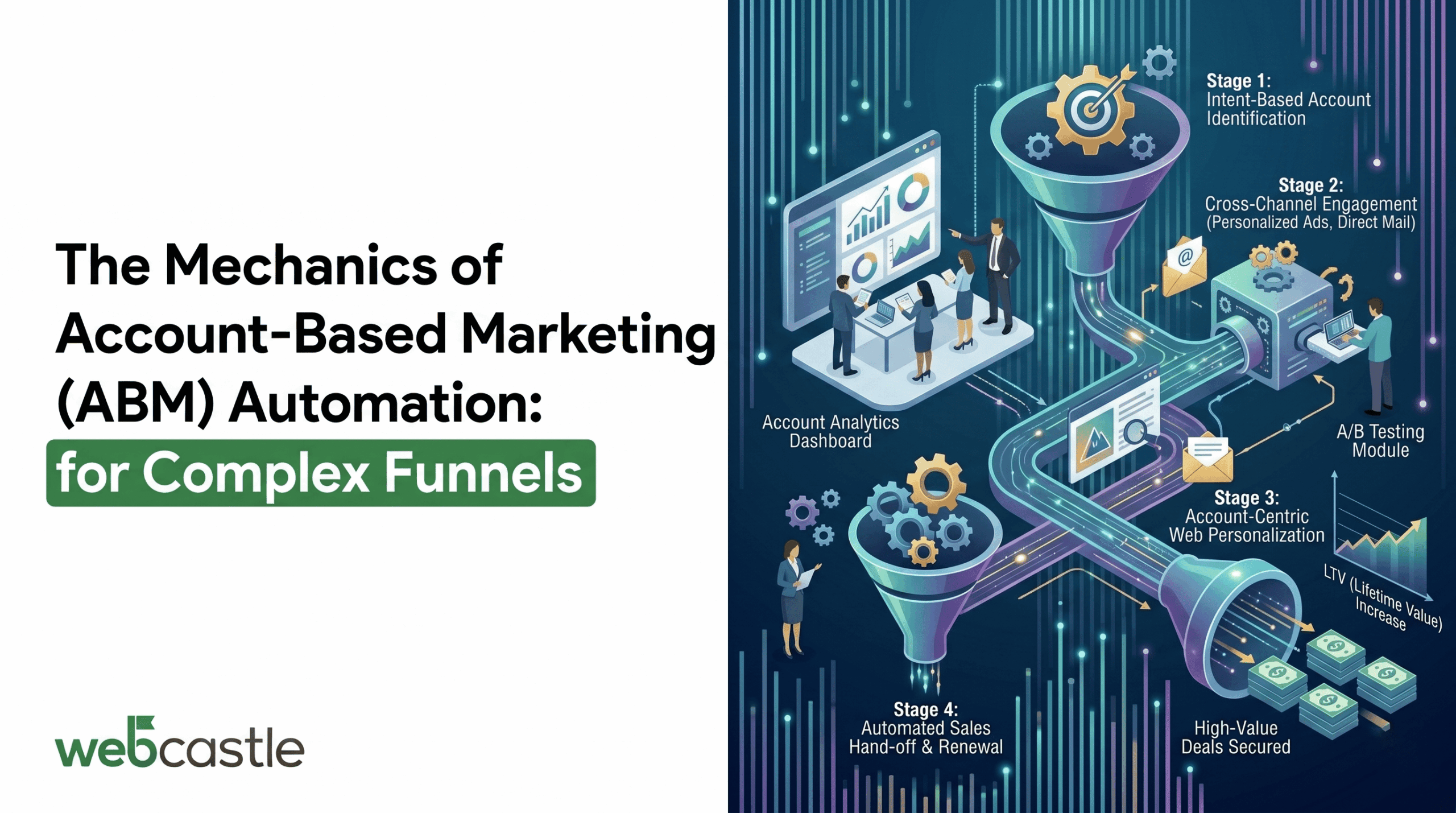
Most B2B companies run ABM like a gut-feeling exercise dressed up in spreadsheets. The ones actually winning? They’ve wired account-based marketing automation into every friction point of their funnel – from tier-1 account targeting and intent data tracking to dynamic content personalization that shifts in real time. This blog breaks down what that wiring looks like, where most teams break down, and what you can do differently starting this week.
Your Funnel Isn’t Complex. It’s Just Broken in Specific Places.
Here’s the uncomfortable truth most marketing consultants won’t say out loud:
Your funnel isn’t failing because it’s too complex. It’s failing because you’re running a broadcast strategy on accounts that demand a conversation.
Think about it. A buying committee at a mid-market SaaS company has, on average, six to ten decision-makers. Each one carries a different fear, a different success metric, and a different tolerance for your pitch. You’re sending them the same nurture email sequence you built in 2022.
This is the core problem statement for complex B2B funnels. The funnel isn’t one funnel. It’s several, running in parallel, across people who don’t always talk to each other – inside the account you’re trying to win.
Traditional lead-based marketing treats a company like a single inbox. Account-based marketing automation treats it like a nervous system – interconnected, signal-driven, and deeply specific.
What is the gap between those two approaches? That’s where revenue gets lost.
What “Automation” Actually Means Here (And What It Doesn’t)
Let’s get this straight. Automation in ABM doesn’t mean “set it and forget it.” It doesn’t mean blasting a sequence and calling it personalized because you swapped in a first name.
Real account-based marketing automation means:
- Tier-1 account targeting that uses firmographic and technographic filters to isolate your actual top-priority accounts – not just the ones that downloaded a whitepaper once.
- Intent data tracking, which captures behavioral indicators as you go through the open web, what your target account is looking for, what competitor accounts they’re reviewing, and what type of content they’re returning to.
- When serving a different landing page depending on the role and engagement history of the visitor, triggered automatically for a CFO than the VP of Engineering, same product, different lens.
- Lead scoring that identifies high-value leads based on account fit, buying stage, and cross-channel behavior, and not just clicks.
- Sales and Marketing Alignment integrated into the workflow, not a meeting once a week, but with a shared CRM view, both teams can access the same account intelligence in real-time.
Each of these isn’t a feature. It’s a layer. And layers only work when they talk to each other.
Where Complex Funnels Actually Break Down
Most ABM programs stall at the same three friction points. Recognize any of these?
Data Silos That Make Intent Invisible
Your marketing automation platform doesn’t talk to your CRM. Your CRM doesn’t talk to your ad platform. Your sales team is working off a two-week-old export. By the time intent signals reach the rep, the account has already chosen someone else.
Intent data tracking only works when it flows. Locked in a platform nobody checks, it’s just expensive noise.
Personalization That’s Surface-Level
You personalized the subject line. Good. But the landing page they hit? Generic. The follow-up sequence? Identical to what a cold lead gets. Dynamic content personalization has to go all the way down – from ad creative to email body to the page they land on to the sales deck your rep sends.
Half-personalization is worse than none. It raises expectations and then immediately breaks the spell.
Sales and Marketing Playing Different Sports
Marketing qualifies a lead. Sales ignores it. Sales finds an “account.” Marketing has no idea how to support it. This is the oldest dysfunction in B2B, and account-based marketing automation doesn’t fix it by itself – it just makes the dysfunction more expensive and faster.
Sales and marketing alignment isn’t a philosophy. It’s a shared data layer, shared definitions, and shared accountability for pipeline – not just MQLs.
The Mechanics That Actually Work
Here’s what a functioning ABM automation engine looks like inside a complex funnel:
Step 1 – Account Intelligence First. Before a single email goes out, tier-1 account targeting pulls together firmographic fit, technographic stack, and intent signals. This creates a live account score – not a static list.
Step 2 – Trigger-Based Personalization When an account hits a threshold – say, three intent signals in seven days – automation triggers role-specific content.
Step 3 – Cross-Channel Orchestration: High-value lead scoring updates in real time. The funnel becomes a living system, not a static sequence.
Step 4 – Sales Handed a Context File, Not a Lead. When a rep picks up the account, they’re not starting cold. They see what content was consumed, what pages were visited, which buying committee members engaged, and what competitors were searched. That’s not a lead. That’s a conversation starter.
The Result Isn’t Magic. It’s Compounding.
None of this works overnight. But the compounding is real.
ABM-aligned sales and marketing teams achieve 36% higher customer retention, 38% higher win rates, and move target accounts through the pipeline 234% faster – figures that emerge not from theory, but from teams that treated their funnel as a system worth engineering.
91% of B2B technology marketers now use intent data to prioritize accounts and build target account lists. That’s not a trend anymore. That’s table stakes.
The question isn’t whether to automate your ABM. It’s whether your current tech stack, content strategy, and team structure are actually ready to support it.
This Is Where the Right Digital Partner Matters
Here’s the honest part: account-based marketing automation is only as good as the infrastructure beneath it. Your website needs to serve dynamic content. Your forms need to enrich data, not just collect it. Your CRM integrations need to be clean. Your analytics need to tell a coherent story.
That’s where most ABM programs quietly die – not in strategy, but in execution. In the gap between what the tool promises and what the tech actually does.
WebCastle builds the infrastructure that powers modern growth strategies. From custom web development and CRM-integrated digital marketing services to SEO-driven content ecosystems that support account-based marketing initiatives, the team in Boston has spent years helping businesses transform ambitious ideas into scalable, revenue-generating pipelines.
If your funnel is complex and your current setup isn’t keeping up, talk to WebCastle.
