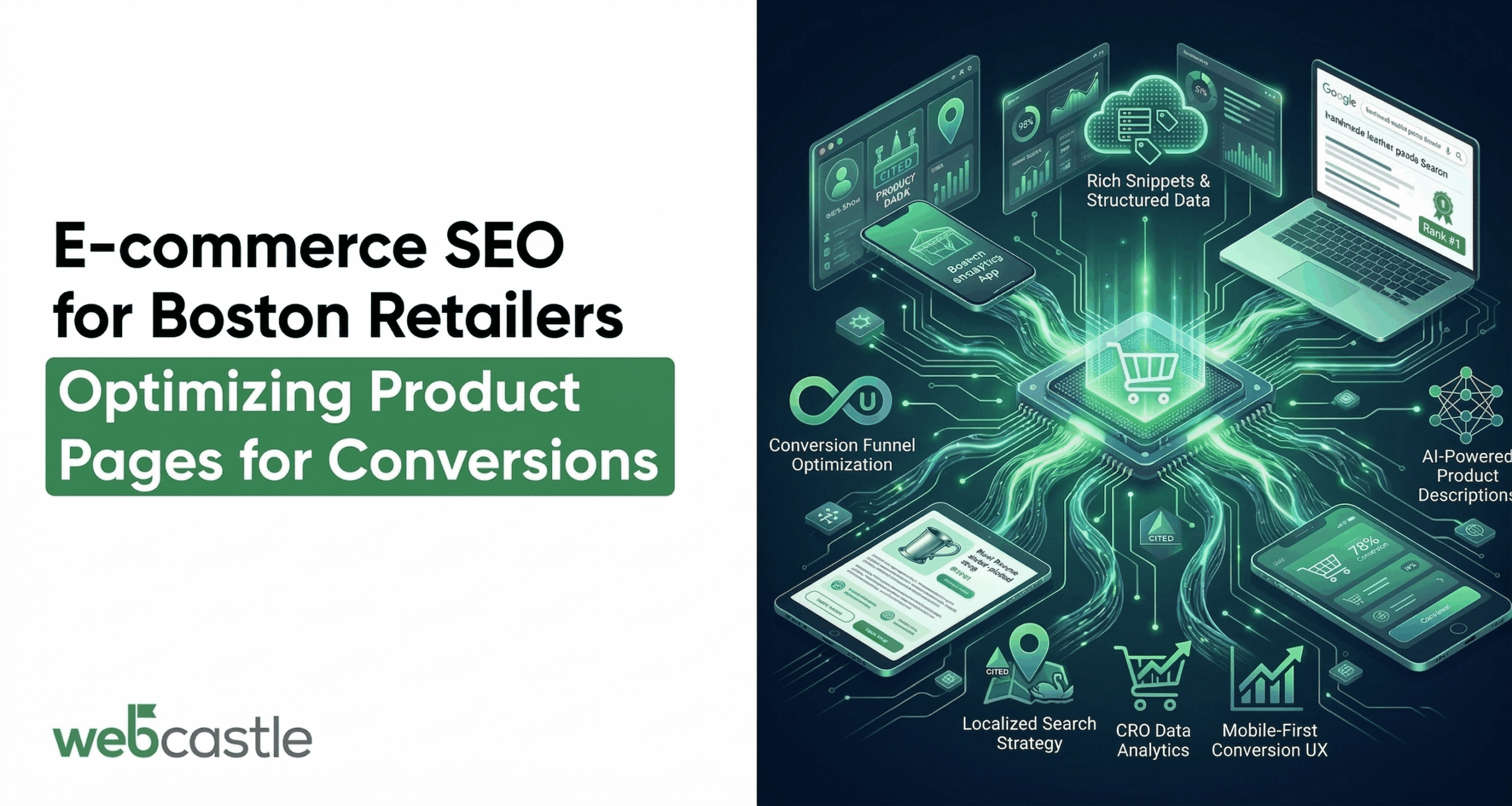
Boston shoppers don’t browse the way they did five years ago. They compare prices on their phones while riding the Green Line, skim reviews between meetings in the Financial District, and expect a frictionless checkout whether they’re in Back Bay, Somerville, or scrolling at home in Quincy. If your product pages aren’t built to both rank and convert, you’re handing that business to a competitor a few clicks away.
This internal blog walks through how to approach ecommerce SEO Boston with a product-page-first mindset—so your traffic is qualified, your pages are persuasive, and your cart numbers move in the right direction. We’ll close by showing how a partner like WebCastle, as a website development company Boston with integrated SEO and UX capabilities, can help turn that strategy into revenue.
Why Product-Page SEO Matters for Boston Retailers
You can’t treat product pages as “just” templates with a title, a price, and a few photos anymore. In a dense, competitive city market like Boston, those URLs are your digital shelf space.
Local realities that affect ecommerce SEO in Boston
- High competition in tight niches:
Local boutiques, DTC brands, and national chains all fight for the same SERP real estate on “near me” and generic product queries. - Hybrid buying journeys:
Customers may discover a product online and buy it in-store, or vice versa. Your product pages need to support all those paths. - Seasonality and campus cycles:
Back-to-school, move-in weekends, and holidays bring sales spikes. Optimised product pages help Boston retailers capture this demand.
Good ecommerce SEO in Boston attracts ready-to-buy local shoppers and guides them quickly to checkout.
Foundations: What Every Product Page Must Get Right
Start with the basics. Most SEO results come from them.
1. Keyword targeting with local intent
For each key product or category:
- Map one primary keyword (e.g., “men’s waterproof boots Boston”) and a small set of related variations.
- Use natural language in:
- Page title
- H1
- First 100–150 words of the description
- Image alt text where relevant
Don’t force “Boston” everywhere, but:
- Mention service areas where relevant (e.g., delivery across Massachusetts, including Boston).
2. Clear Product Copy That Converts
Boston shoppers are busy and smart. Your copy must:
- Answer basic questions fast:
- What is this?
- Who is it for?
- Why is it better than the alternative?
- Highlight benefits before specs:
- “Stay warm on Beacon Hill winters,” instead of just listing insulation thickness.
- Use scannable formatting:
- Short paragraphs
- Bulleted lists
- Use clear subheadings: Fit, Materials, Care, and Shipping.
Search engines reward engaging pages.
3. High-quality visuals that load quickly
Images help sell products, especially in fashion, home, and lifestyle.
- Use:
- Multiple angles
- Close-ups of texture or detail
- Context shots (e.g., Boston apartment setting)
- Optimise:
- Compress images without quality loss.
- Use formats like WebP.
- Add alt text for SEO and accessibility.
On Shopify or other platforms, this is where Shopify development Massachusetts expertise pays off—balancing aesthetics with speed so you don’t lose conversions on mobile.
Technical Elements That Lift Rankings and Conversions
Strong content with weak technical implementation is like having a great store with a broken front door. These technical pieces are non-negotiable.
1. Product schema markup
Product schema markup helps search engines understand your:
- Product name and description
- Price and currency
- Aggregate rating and review count
Benefits include:
- Helps show rich results in Google, improving CTR.
- Keeps search listings consistent with the page.
2. Clean site structure and internal linking
For growing catalogues, especially on custom builds or Shopify:
- Use descriptive, simple URLs:
- /mens/winter-boots/boston-leather-boot rather than /product?id=1234
- Keep category and product relationships logical.
- Internally link:
- From blog posts to relevant products.
- Between related products and variants.
A technical e-commerce audits pass should verify that:
- Important product pages are indexable.
- There are no unnecessary duplicate URLs for the same item.
- Canonical tags are correctly set.
3. Mobile experience and core web vitals
Most retail traffic in urban US markets is mobile-first. Boston is no exception.
- Test product pages on real devices:
- Is the “Add to Cart” visible without scrolling?
- Are thumbnails easy to tap?
- Is the checkout smooth or slow?
- Monitor:
- LCP (Largest Contentful Paint)
- CLS (Cumulative Layout Shift)
- FID / INP (interactivity)
A Boston digital marketing company or SEO agency Boston that understands UX and performance can build this in from the start.
Turning SEO Traffic into Sales
SEO brings visitors; optimisation converts them.
Reduce cart abandonment
- Trust signals:
- Clear returns and refund policy near the CTA.
- Security badges and payment logos at checkout.
- Local cues: “Ships from Massachusetts” or “Boston-based support.”
- Social proof:
- Star ratings and reviews above the fold when possible.
- User photos or short quotes from local customers.
- “X people in Boston bought this in the last 30 days.
Strong UX and clear messaging reduce cart abandonment.
Where WebCastle Fits: From Strategy to Implementation
Doing all this while managing daily operations is tough. That’s where WebCastle, a Boston website development company, can help.
How WebCastle supports e-commerce SEO Boston
- SEO-aware development and design:
Product templates, navigation, and internal linking are built from day one with search visibility and conversions in mind—not retrofitted later. - Integrated Boston digital marketing services:
As a digital marketing company in Boston, WebCastle can align your product page SEO, email flows, paid campaigns, and online retail marketing efforts so you’re not working in silos. - Platform-specific expertise:
From custom builds to Shopify development in Massachusetts, the team optimises sites for speed, SEO, and UX. - E-commerce audits and support:
Regular e-commerce audits catch issues early—like broken schema, index bloat, and slow mobile pages.
Boston retailers can focus on products while the tech supports SEO and conversions.
Turn Product Pages into Your Best Salespeople
In a city as competitive and fast-moving as Boston, your product pages are often the first and last chance to win a customer. When they’re optimised for search and built to convert, they don’t just attract clicks—they close sales.
If you’re a Boston retailer wondering where to start:
- Pick 10–20 of your highest-margin or highest-traffic products.
- Run them through the checklist in this post—content, schema, mobile UX, and trust elements.
- Fix what you can internally; note what needs dev or SEO help.
When ready to scale, partner with a team that understands code and commerce. Visit WebCastle to explore how a Boston digital marketing services and development partner can help you implement e-commerce SEO Boston best practices, tighten up your product pages, and turn more visitors into paying customers.
Start with one category, one product line, one page. In crowded markets, that’s often all it takes to get a measurable lift—and build momentum for the rest of your catalogue.
Improve your product pages and boost online sales with WebCastle, a trusted SEO agency and website development company in Boston. Get started today.
